
Sabrina Leidelmeijer · hypnobirthing teacher and doula at PUUR Zwanger
Nearly 100,000 births later: what we now know about hypnobirthing
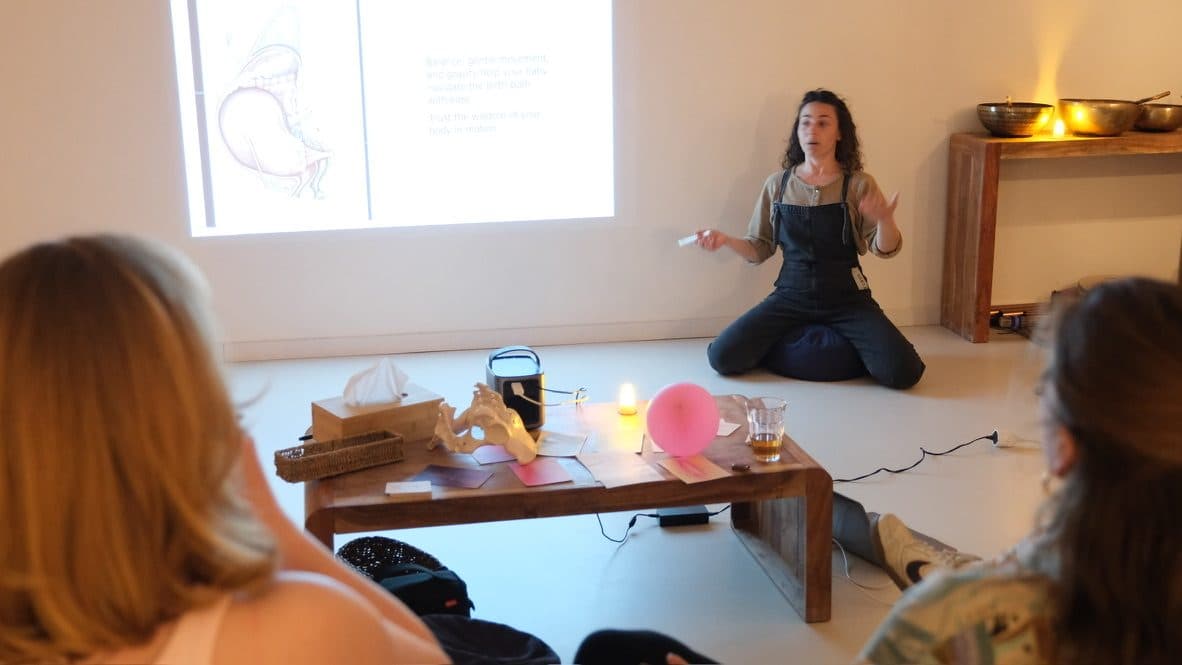
He always comes up in the course: Grantly Dick-Read, the English doctor who in the nineteen-thirties wrote down what he saw happening at the foot of the bed.
His idea was simple. Fear creates tension, tension creates pain, and that pain makes the fear greater again. He called it the fear-tension-pain cycle. His conclusion: take the fear out and the whole system starts working differently. In his book Childbirth Without Fear he describes women who gave birth calmly and with wonder, at a time when that was almost unthinkable.
Dick-Read had a sharp eye and years of experience. Figures were missing. His work consists of what he saw, and for ninety years that has remained the weak spot of everything built on it, hypnobirthing included. Marie Mongan based her method directly on it in the nineteen-eighties.
Since May 2026 there is something else on the table.
Almost 100,000 births
Australian researchers looked at the birth records of a large region, over thirteen years. In total 137,489 births between January 2011 and June 2024. After taking out the planned caesareans and the twins, almost 100,000 remained. About half of those were first children.
Then they did something clever. For every woman who used hypnobirthing they found a woman who resembled her as closely as possible and did without: the same age, the same stage of pregnancy, also a first or a later child. That way you compare two groups that genuinely resemble each other, instead of apples and pears.
The study appeared in Women and Birth, the journal of the Australian midwives.
What came out
Three things stood out clearly among the women who used hypnobirthing during their birth. They had an epidural less often. They went into the bath more often. And they gave birth under their own power more often, so without ventouse or forceps.
The researchers also checked whether the bath was the explanation, because giving birth in water lowers the chance of an epidural on its own. These turned out to be separate. So hypnobirthing did something by itself, and together with the bath it probably works more strongly still.
Among the women having their first child there was something more. They had a caesarean less often. The original article gave a figure there that the authors themselves corrected in June 2026: the chance was lower than first published. The confidence interval stayed the same.
Their recommendation is, for researchers, fairly outspoken: maternity care should look at how women can gain easier access to hypnobirthing.
So ninety years after Dick-Read his idea is there in figures, in the journal of the profession itself.
What it still leaves open
For anyone who wants to check everything, and that is a fine reflex: here is the small print.
There is something you always keep in the back of your mind with this kind of research. The women went to a course themselves; no lottery decided who took part. Someone who signs up for hypnobirthing may prepare more thoroughly anyway, may want a water birth anyway, or may look for a midwife who goes along with that. Those differences have partly been accounted for and you can never remove them entirely.
Earlier studies on hypnobirthing covered dozens to a few hundred women. Almost a hundred thousand births is of a completely different order.
From seeing to knowing
Dick-Read described how he thought it worked. Our current knowledge about stress in the body fits that well: the substance released when you startle and the substance that drives your surges go together badly. A body on alert makes the work of the womb heavier.
Since May 2026 there is large-scale research as well. And the conclusion is still the same as that of an English doctor in 1933: a woman who feels safe gives birth differently.
What this means for you
You probably already hope that this works, otherwise you would have clicked away long ago. This research adds that you can back that hope up. Towards your midwife or obstetrician, and towards the people around you who find it sounds far-fetched.
Honestly though: it has never been a guarantee. A birth is hard to direct. What you do have in hand is how prepared you go into it, how much you understand of what happens in your body, and what there is for you to do at the moment it gets tense.
At PUUR Zwanger we work with techniques from hypnobirthing: relaxation, breathing, visualisation and insight into the birth process. Practical and with both feet on the ground, for you and your birth partner, in small groups of no more than seven couples.
Sources
Lee, N., Kearney, L., Jenkinson, B., Howlett, C. & Ballard, E. (2026). The association between women's use of HypnoBirthing and maternal labour analgesia use and mode of birth: a retrospective propensity score matched study. Women and Birth, 39(3), 102215. doi.org →
Correction to this: Lee, N., Kearney, L., Jenkinson, B., Howlett, C. & Ballard, E. (2026). Corrigendum. Women and Birth, 39(4), 102217. The odds ratio for a caesarean among women having their first child appeared in the original article as 0.93 and is 0.69. doi.org →
Dick-Read, G. (1942). Childbirth Without Fear. On the fear-tension-pain cycle, the foundation under hypnobirthing as Marie Mongan later developed it.