
Sabrina Leidelmeijer · hypnobirthing teacher and doula at PUUR Zwanger
Nonviolent Communication in maternity care
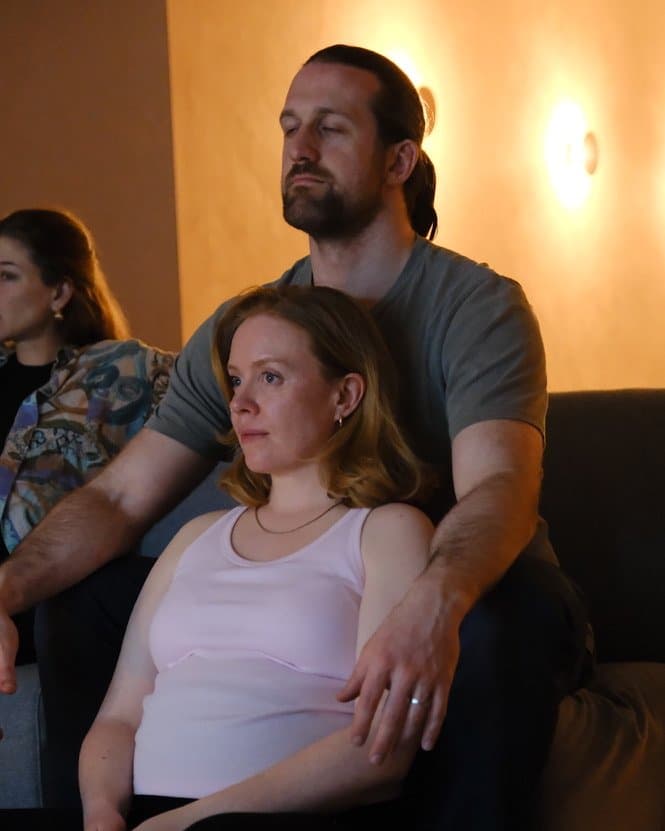
Nonviolent Communication, based on the work of Marshall Rosenberg, is one of the foundations under the way I work. At its heart are four steps: observing without judgement, feeling what is going on in you, discovering which need lies underneath, and asking for something from there. Not a script for talking differently, but a way of staying closer to yourself, precisely in the moments when that is hardest.
Take the moment when surges grow stronger and you feel you are losing your grip. Many women tell me that something shifts in them then: they go quiet, or sharp, or withdraw into themselves. Underneath that reaction there is often a simple, strong need: trust. Trust that your body knows what it is doing, trust that the people around you will not let go of you. Feeling that need out loud, even if only to yourself, changes something. You do not have to know how to say it. Feeling it already gives you something to hold on to.
Or the moment when a hospital room is suddenly full of people, equipment and bright light, while you were just turning inwards. What often lies underneath there is a need for relaxation: room to keep breathing, to let your body do its work without everything around you breaking in on it. Knowing that this is what you need gives you something to ask for: less light, a voice that speaks more softly, a moment without questions. Relaxation is simply what a birth asks for, and asking for it is allowed out loud.
Your partner has an inner world of their own during those hours too. I often see partners who want to be there but do not know what to do, and who end up standing quietly and uncertainly on the sidelines. Nonviolent Communication does not hand you a ready-made sentence for that moment, but it does give you a direction: your partner has a need as well, for something to hold on to, for instance, or for the feeling of being useful. When that need is allowed to be there, contact between the two of you often returns by itself, exactly when it is needed most.
There is also the conversation you have with yourself. Self-compassion is a form of Nonviolent Communication that is easily overlooked. The moment you hear yourself thinking that you are not doing it well, or that you should have prepared for this differently, those same two needs often lie underneath: trust and relaxation. Recognising them, without immediately wanting to solve them, is already a form of connection with yourself.
In the course we take plenty of time to learn to recognise these needs, in yourself and in your partner, so that trust and relaxation get words you can fall back on when it matters, instead of being something you have to force. That is exactly where hypnobirthing and Nonviolent Communication meet: both build on the wisdom that your body, and you, already know what is needed.